Thoughts
What is the greatest competitive advantage today? A brand that feels as good to interact with as the product feels to use.
Global brands like Nike once had this on lock. Today, not so much.
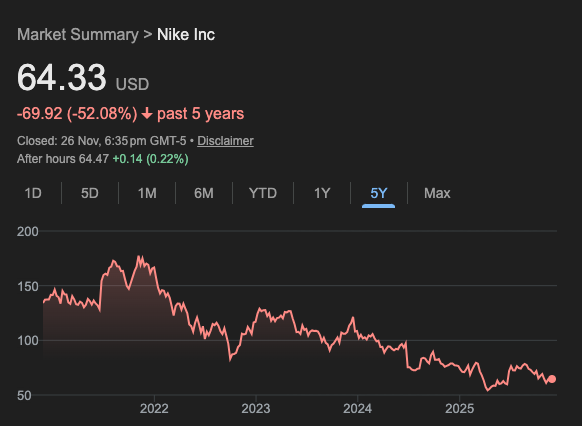
The once iconic swoosh that defined culture for decades has become one of the most referenced downfalls in retail’s recent memory. This isn’t a dramatic headline; it’s the result of structural issues. And the Nike decline case study reveals exactly where things went wrong.
So what happened? Sure, Nike still has great products, decent storytelling and decades of cultural clout.
Sure, Nike still has great products, strong product development, recognisable storytelling and decades of cultural clout.
However, momentum has steadily declined in ways that have captured just about everyone by surprise, including its own competitors.
What happened in the meantime?
Adidas has resurged (marketing week).
On’s growth has exploded (Fortune.com).
Hoka went from niche to mainstream (Runners World).
Even smaller players have been able to carve out meaningful market share.
This is a direct result of brand misalignment - the widening gap between its brand promise and what customers feel in real-time across key touchpoints throughout their customer journey.
Go a level deeper, and the Nike brand misalignment becomes clear. It came from a series of strategic errors, not just one:
- A tone that shifted from inclusive to exclusive
- A digital-first strategy that had great intentions, but ultimately resulted in inconsistent and frustrating user experiences
- A distribution play that tightened in ways that restricted customer access
- Marketing campaigns that felt disjointed instead of aspirational
“It’s overly aggressive and uncompassionate tone — values at odds with Nike’s traditional inclusive and empathic narrative.”
- The Robin Report
Nike’s stumble isn’t an anomaly. It’s a high-visibility truth and universal pattern we’re seeing more and more: digital misalignment examples stacking slowly, then all at once.
And as a result, it’s clearer than ever that in 2026, even the greatest products won’t sell themselves.
Why Great Products Don’t Sell Themselves
Even with strong attributes such as high customer satisfaction, positive reviews, strong customer engagement, and marketing that drives plenty of attention, internal growth can still feel fragile, inconsistent, and unpredictable.
It begs the question: is your strongest advantage the product itself, or the specific customer experiences and proof points that reinforce its value?
When digital touchpoints fail to deliver reinforcement, often subconsciously, curiosity fails to convert into confidence. And confidence is what drives conversion.
Why? Because in today’s market, less confidence equals less trust, which drives sales elsewhere - to brands that can build trust faster and more consistently, regardless of whether their products are objectively better or worse.
That's customer journey friction in a nutshell.
Where Brand Misalignment Begins
Brand misalignment rarely starts loud. It starts with subtle inconsistencies and unnoticed fractures:
- A design update that doesn’t accurately reflect the brand.
- A website change that confuses more than it clarifies.
- A brand promise that isn’t reinforced throughout the customer journey.
- A marketing strategy that focuses on reach but not resonance.
These small cracks compound over time - and they directly affect the bottom line. Below are the four most common areas where misalignment becomes expensive.
1. The Digital Brand Experience Doesn’t Match the Product
A digital channel is often the first point of brand interaction, and therefore the most common site of misalignment.
You may have a premium product that’s beautifully crafted and widely recommended, but customers will downgrade their expectations the moment they encounter:
- Outdated look and feel
- Generic content
- Inconsistent brand experience
- Confusing UX/UI
- Slow performance
- Visuals that don’t match the narrative
-
Lack of clarity at key decision points
In 2025 and beyond, digital user experience is directly tied to brand equity, and your website experience is part of the product until proven otherwise. Failing to optimise it results in customer journey friction long before price, features, or brand values even enter the conversation.
If you’re aiming for high-quality customer experience, your digital experience must be a top priority, both from a design and a technical perspective.
2. Brand Positioning Doesn’t Reflect What Customers Value Most
Brand positioning is often shaped internally, but it’s customer feedback that reveals what the brand actually means, and even where competitive advantage show up with clarity.
Key Signals:
- what customers emphasise
- what they recommend
- what benefits they repeat
- what pain points they say you solved
- what they say your product “feels like”
That’s why consistently sourcing customer feedback should be fundamental. We’re in a trust-driven business environment now more than ever.
If your brand voice, messaging, or narrative contradicts what loyal customers believe, your brand will drift. Nike is the perfect (and painful) example of this.
3. Curiosity Rises, But Confidence Does Not
Many successful brands today excel at top-of-funnel:
- high engagement
- strong content
- creator partnerships
- shareable moments
- efficient marketing campaigns
These efforts certainly create curiosity, but curiosity is not conversion.
The gap between curiosity and confidence is the difference between a customer interacting with a brand and purchasing from it. That gap widens significantly when misalignment is layered throughout the journey.
To move customers through your funnel more effectively, brands must continuously close the cracks that form through misalignment.
4. Mixed Signals Erode Brand Trust
Brand trust doesn’t come from one touchpoint, but instead from the consistency of many.
Misalignment shows up in places like:
- warm tone on socials vs cold tone on the website
- premium product vs slow checkout
- bold innovation vs outdated design
- purpose-led brand vs no proof across digital touchpoints
- luxury pricing vs mediocre user experience
- confident narrative vs unclear product benefits
Customers feel these inconsistencies immediately, even if they can’t articulate them. When trust breaks brand loyalty becomes much harder to sustain.
Takeaways For Every Brand
Nike’s challenges aren’t “Nike-specific problems”. They’re 2025+ brand problems.
Every brand today must recognise this truth:
The experience customers interact with is now the brand, not the product.
When misalignment is left unaddressed, clarity breaks down, confidence fades, resonance disappears, and growth stagnates.
How to Realign Your Brand in 2026
With 2025 nearly behind us, now is the moment to prioritise building an aligned brand for 2026. Before redesigning your website, launching new products services, or investing in more content, consider discovering your realignment path with us in the following areas:
1. Surface hidden brand truths
What are your best customers telling you? This is the foundation of brand equity, brand loyalty, and brand promise.
2. Does your digital experience accurately reflect this?
Use a combination of UX/UI and data-driven insights to see where signals of perceived quality can improve across the customer journey.
3. Remain consistent
Consistency drives trust. A test-and-learn approach should always be fundamental to your digital experience strategy.
The Value of Being Aligned
If your product, story, and digital experience align, you’ll notice:
- customer loyalty and satisfaction strengthen
- retention becomes easier
- conversion rises without more traffic
- acquisition becomes cheaper
- your organisation gains clarity and focus
This is how great brands are winning today:
Not with volume.
Not with hype.
But with alignment.